
In the heart of the hustle and bustle of Los Angeles sits California State University, Los Angeles, right off the busy Interstate 710.
Los Angeles traffic is notorious for its congestion, but the I-710 stub — the spot where the freeway ends abruptly — can make it even harder for Cal State LA commuters to get to class safely and on time.
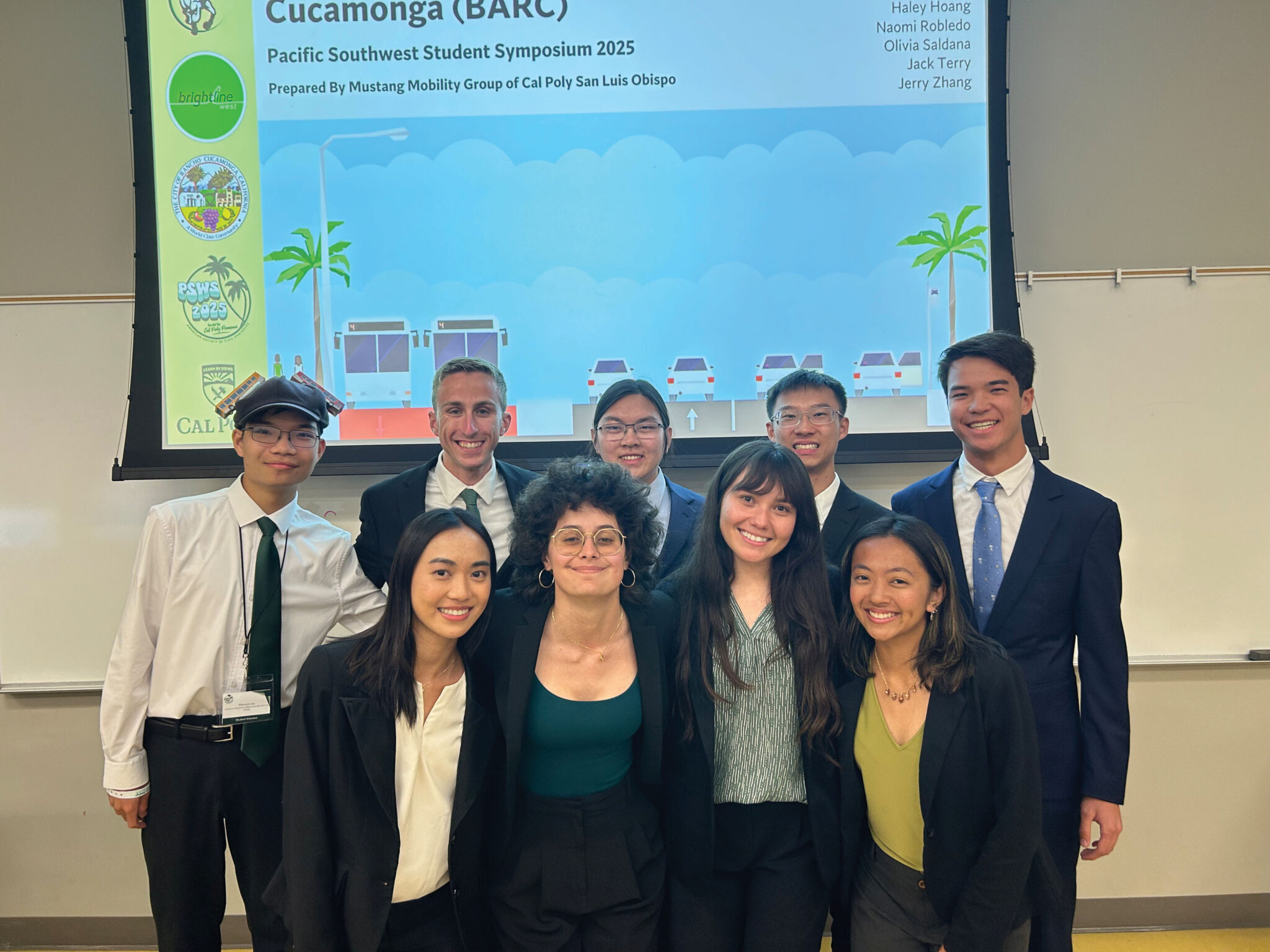
Enter Cal Poly’s Institute of Transportation Engineers (ITE) student chapter. The group was introduced to the I-710 problem as part of the American Society of Civil Engineers’ annual competition. Their goal? To develop a plan to repurpose the canceled freeway into an active transportation corridor that provides connectivity to nonmotorized networks and a major transit hub.
“There are a lot of transit connections on the freeway for us to tap into, and since the university is right there, there’s a lot of potential and need for these sorts of improvements,” said Olivia Saldana, Cal Poly’s ITE chapter president.
The Institute of Transportation Engineers team at Cal Poly is an organization dedicated to connecting and educating transportation professionals. This year, 11 of the group’s members will take part in the American Society of Civil Engineers competition, hosted by Cal State LA.
“I’m taking this as an opportunity to get practice with a different kind of project and the challenges of dealing with higher-speed roadways and a very three-dimensional environment,” said project manager Marcus Lau. “Ideally, the changes we propose will still allow drivers to get around this part of Los Angeles as they do with the current freeway setup while building new connections for cyclists and pedestrians between residential neighborhoods, the Cal State LA campus and the Cal State LA transit center, which provides wider regional connections.”

Presenting their project comes with its own set of challenges, including answering technical questions from the competition judges.
“My personal goal is to get more comfortable presenting in front of a large crowd,” Saldana said. “All the other Cal Poly teams try to go to every competition, so the room is always packed with more than 50 people while we’re presenting. This is one of the biggest reasons why I joined the team, other than loving transportation.”
The overarching competition takes winners from different categories — concrete canoe, timber design-build and more — and combines their final scores to determine which university takes home first. Last year, Cal Poly’s transportation team placed second and contributed to the school’s overall first-place win.
While placing first is an obvious goal, the real win lies in solving a longstanding problem.
“Our solution is to increase multimodal connectivity by making it easier for the surrounding neighborhoods to access the freeway transit stop adjacent to Cal State LA,” Saldana said. “This would benefit drivers because the more people who take transit, walk or bike, the fewer drivers there are and, therefore, the less congestion there is on the road.”
The 2026 competition will take place at the end of March.