
In spring 2025, Cal Poly professor Paulo Iscold queued up a trailer for “Mission: Impossible — The Final Reckoning” in his senior aircraft design course. On screen, a vintage biplane climbed with Tom Cruise clinging to its wing, the airplane pitching and banking in a stunt sequence built for real flight.

When the clip ended, Iscold asked, “Do you wonder how they pulled that off?” He opened a presentation on his laptop and clicked to a slide filled with diagrams and airflow sketches. The room went quiet.
Then he told them the part they weren’t expecting: he’d walked through the same material with the team making the movie. This time, silence gave way to shouts and laughter.
Iscold was brought in to help engineer the aerial sequence, selecting the aircraft, mapping maneuvers that were safe and camera-ready, and coordinating the flight tests and the camera plane that made the close-ups possible.
Now that the film is streaming, most viewers see only Cruise on the wing. In Iscold’s class, students saw the engineering that made it possible.
A 4 a.m. call from England
The path to that classroom reveal started five years earlier, with a 4 a.m. phone call from England. On the other end was British pilot Paul Bonhomme, a world champion aerobatic pilot and longtime collaborator from Iscold’s Red Bull Air Race days. The ask was simple in words and complicated in practice: help plan and validate a biplane sequence for “Mission: Impossible 8.”
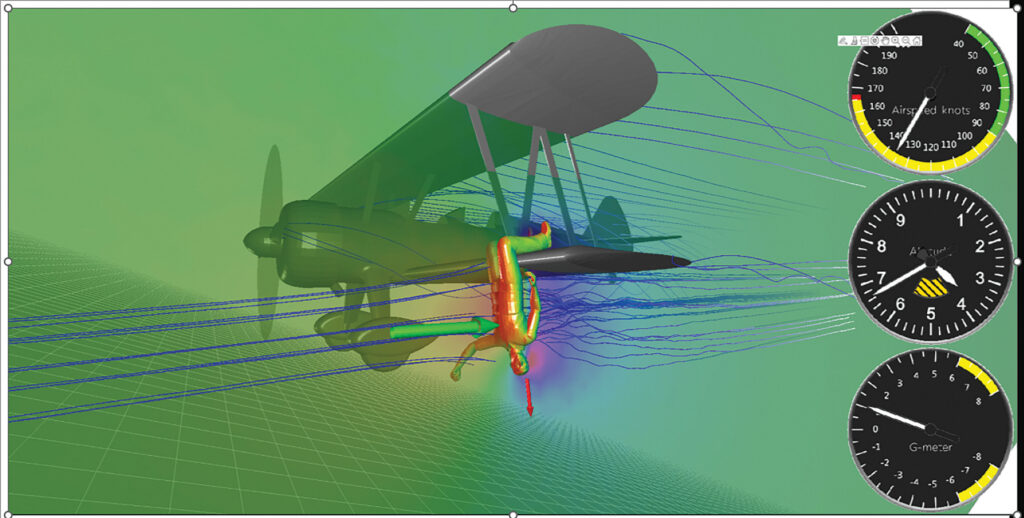
Early ideas included a dramatic descending spin with Cruise holding a wingtip. Iscold began running simulations, calculating loads and forces on both the aircraft and the person outside it. It became clear the stunt needed rethinking.
“We moved quickly to what was feasible, safe and cinematic,” Iscold said. “Everything was calculated, tested and verified. Nothing was left to chance.”

Balancing the aircraft with a person on the wing became one of the central questions. In the concept phase, Iscold considered a dynamic ballast system that would pump water between the wings to keep the airplane in trim. It was one of several creative approaches on the table, and it remained only an option explored during analysis.
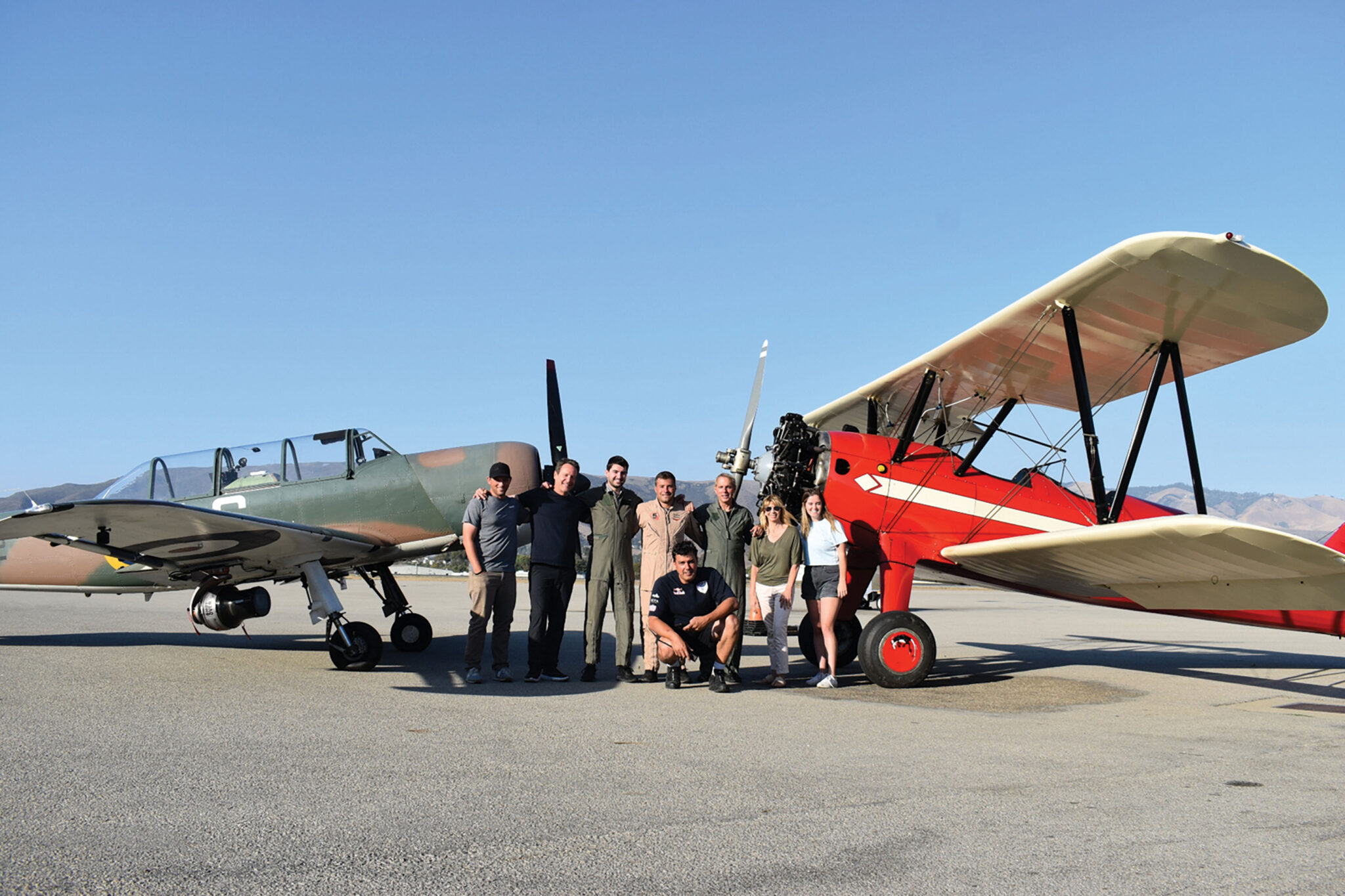
To move from theory to proof, the team brought in California pilot and aerobatic performer Vicky Benzing. Iscold’s group fitted the biplane with a precision positioning system and had Benzing fly scripted profiles, logging data for each maneuver. The flights showed what Cruise could handle and how to stage shots that would read on camera. After each flight, a Paramount courier drove the footage to Los Angeles under strict security that Iscold later joked was “more secretive than the military.”
The production had two goals: modify the biplane so the actor could move safely along the wing and ensure viewers could see Cruise’s face. The second goal required a dedicated camera plane — a Yak-52 previously used in “Dunkirk” — that Iscold helped equip with a stabilized rig under its wing. Because Cal Poly didn’t yet have a hangar at the San Luis Obispo airport, the team worked on the ramp, reinforced the Yak’s wing to support the camera load and flight-tested the setup in September 2021.
The aircraft went on to capture the aerial close-ups that turned the stunt into something filmable, flying in perfect formation with the biplane against an open sky.
Case study in flight
The stunt quickly became a case study in Cal Poly’s senior aircraft design course. Andrew Grant, who was in the class at the time and is now an aerospace engineer at a tech startup in San Diego, said the timing was perfect. They were deep into mass properties, using the stunt to test G limits and the trade-offs between bank angle and turn radius. “You do not want your lead actor blacking out,” he said.
When the movie came out, Grant pulled the class back together. He organized a trip to the downtown San Luis Obispo theater and added Iscold to the email. “I’ve never seen him reply faster,” he said, laughing. “He wrote, ‘I’ll be there.’” About 35 students from the aircraft design course filled the seats, waiting for the biplane scene. It didn’t appear until late in the movie, but when it finally did, the group lit up.
Connor Johnston, a graduate student and close friend of Grant’s, said the reveal changed how he saw his professor’s work. “We knew Paulo had done cool things with Red Bull, but hearing almost casually that Paramount reached out was something else. It felt like another chapter in his legacy. My professor, the one I saw five days a week, worked on that,” he said.
Grant said it also changed how he watched the film. “I’m a huge fan of the ‘Mission: Impossible’ movies, so realizing my professor had helped make that sequence work was surreal,” he said. “As far as movie stunts go, it’s definitely in my top three.”
A career built on flight and fun
Iscold’s route to Hollywood follows the same unconventional arc that defines his career. Before joining Cal Poly’s Aerospace Engineering Department, he designed aircraft that set international speed and time-to-climb records and supported Red Bull Air Race teams that won championships. He has worked as a consultant for companies including Embraer and Boeing, and his student projects range from sailplanes to high-performance prototypes. His students know him as a hands-on pilot who still lights up around airplanes.
He says projects like “Mission: Impossible 8” remind him why he became an engineer.
“I do these projects because they’re fun,” he said. “The preparation is so thorough that it’s safer than it looks. It isn’t recklessness; it’s discipline and creativity.”
That ethos has rubbed off. Grant credits his senior design experience and Iscold’s mentorship with setting his career in motion. He has already signed up to mentor Cal Poly students and hopes to serve on the department’s Industry Advisory Board one day.
“Iscold changed my life for the better,” Grant said. “He showed us that engineering is not just equations. It’s imagination, teamwork and the nerve to try something no one has done before.”
Back in that classroom, after the trailer and the reveal, the questions came fast. Slides showed flight paths and load charts. Could the sequence be flown in tighter airspace? How much drag would the camera mounts add? Iscold closed with one more slide, showing the trade-offs that turn theory into safe flight.
The room quieted, then came alive again as students connected the equations to the moment on screen. Learn by Doing — in its loudest form — had just taxied in and taken off.