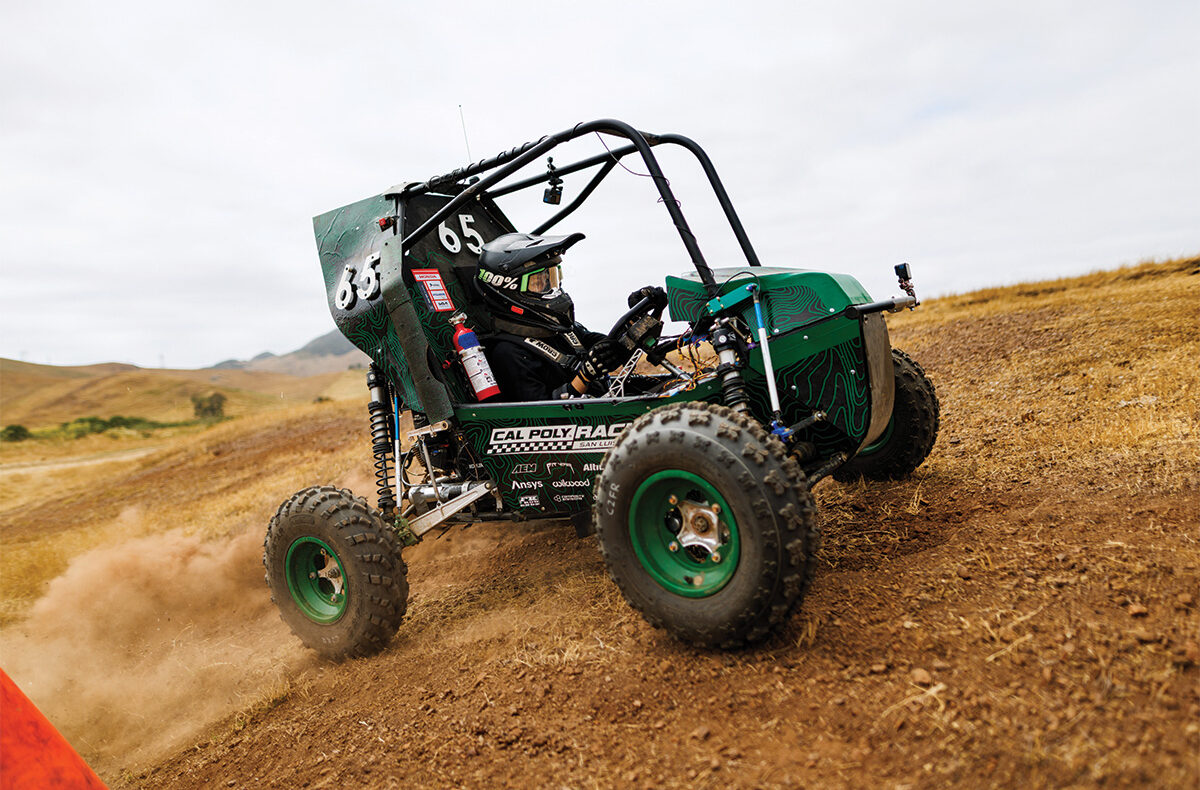
When alumna Kathryn Webb walked into the Hangar machine shop last year, she slowed at the sight of Cal Poly Racing’s Baja car and the women gathered around it. Students leaned over the chassis, calling out measurements and adjustments as they worked. At the center was suspension lead Selina Bayles, confident in a role earlier members had to fight to earn.
That season, nearly half of Baja’s leads were women, a milestone Webb couldn’t have imagined.
“It gave me chills,” Webb said. “We were told we weren’t good enough, so we had to prove it. To see women working on the car like that, it means the whole environment has changed.”
With more than 125 members, Cal Poly Racing is the largest student chapter of SAE International in California. Each year, students design, build and test two competition vehicles — a Baja off-road vehicle and a Formula electric race car — while the Business Team supports operations and partnerships. That work culminates in Collegiate Design Series events across the United States, where Cal Poly Racing has recorded top-10 finishes and earned awards in design and dynamic events.
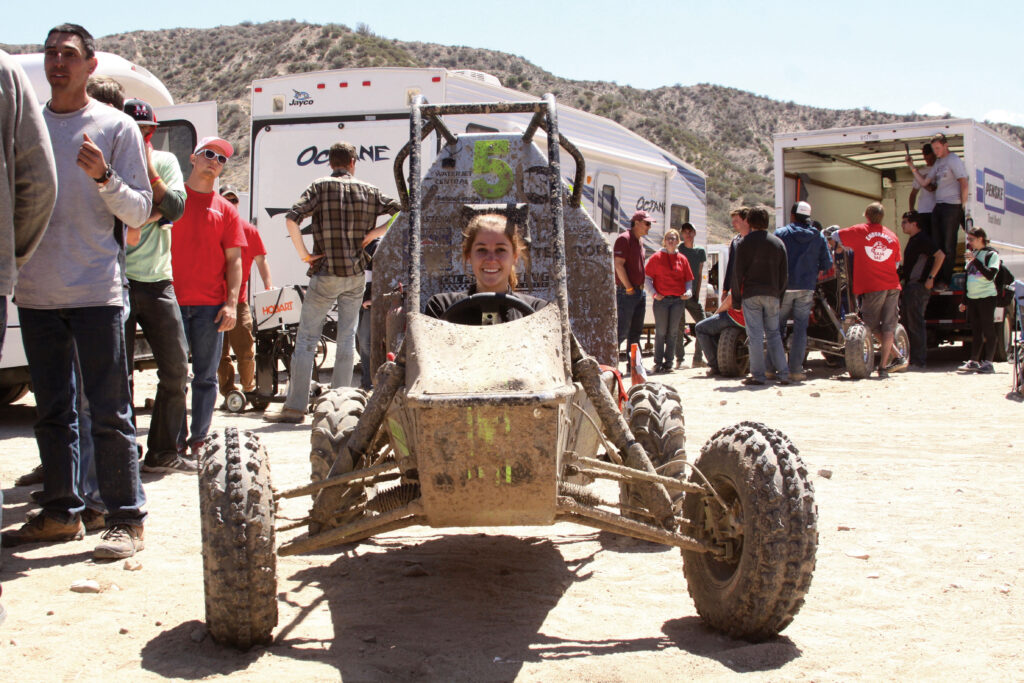
Race day wasn’t the hardest part for Webb. A decade earlier, as the only woman on the Baja team and one of two in her manufacturing engineering major, she was trying to carve out a place for herself long before the car left the Hangar. She had welding experience and tinkered with a Volkswagen Bug, but she still entered the machine shop knowing she’d have to outwork everyone just to be accepted. Night after night, she kept showing up until teammates finally gave her critical tasks.
In a student-run program like this, change builds over seasons. That progress traces back to years when women joined in ones and twos, pushed through doubt and slowly reshaped Cal Poly Racing from within.
The Years When Women Fought to Stay
Much of Cal Poly Racing’s authority sits inside its vehicle teams, where key design and manufacturing choices are made long before competition season. For years, those spaces were difficult to enter. New members were welcomed, but meaningful roles stayed with returning students who knew the systems well. For women in particular, access to subteams like suspension, chassis, powertrain and electronics often shaped whether they influenced the project or drifted to the margins.
In the mid-2010s, women began holding central positions on both teams. They took on subsystems, stayed through long build cycles and began teaching others, gradually changing the makeup of team leadership.
By 2016, when she became president, Webb could feel how fragile those gains still were. She spent as much time managing team dynamics as refining the car, advocating alongside a small group of peers for more teaching and a more open shop. The effort mattered, but the strain eventually led her to step away from Racing.
“It was the right fight,” Webb said. “But it took a toll.”

That push opened doors for others. Mechanical engineering student Jessalyn Bernick remembers her first Baja Build Week shift running late into the night, working through a chassis part she’d never designed before and asking questions as she went. For the first time, her design ended up on the car.
“I learned it was OK to say, ‘I don’t know,’ and move forward anyway,” said Bernick, who later served as Baja’s systems lead. “You can be wrong, learn from it and keep going.”
Similar dynamics were unfolding on Formula. Gina Ghiglieri was one of two women on the team and one of eight women in an aerospace cohort of about 100 students, and she was used to being second-guessed.
“I felt doubted all the time,” she said. “Maybe it was the environment, and maybe some of it was internal, but I knew I didn’t want other women to feel that way.”
As composites lead, she created entry points that kept newcomers coming back, including a carbon-fiber bookmark workshop that sent new members home with something they made. Later, as operations lead, she encouraged subteams to run demonstrations in the same spirit.
Mechanical engineering student Esther Unti moved further into the team’s core, working in suspension and later becoming technical director — a visible, high-stakes role at the center of the car.
“When I became a leader, I could support other women in the way I’d needed when I started,” she said.
After graduation, Unti returned to the Formula SAE circuit as a design judge. At one competition, she was one of three women among about 70 judges. The imbalance reinforced what she had learned as a student: who holds visible authority shapes the culture around it.
Looking back, Unti said she came up at “the right time in history,” as the culture on the team and in the industry began to shift.
The New Generation
Today’s Cal Poly Racing looks different, not just in who shows up, but in who leads. When Lucia Giacalone walked into her first Baja work night in 2022, the room was intense but immediately welcoming. It wasn’t the kind of first night earlier women described.
“You come for the engineering and stay for the people,” she said. “All my best friends are here.”
During the design-season stretch before both teams moved into the Hangar, Baja took over a classroom in Building 192. Laptops glowed with CAD models as leads made rounds and subteams checked geometry, compared designs and traded jokes.
This year, Giacalone shares a house with Bayles, logistics director Claire Cornelsen and powertrain lead Emma Penders, all mechanical engineering students. The house feels like an extension of that classroom, with homework and competition prep sharing the same kitchen table.
That sense of looking out for one another is what sets the team apart, Giacalone said. “Students need to know the people in charge care about them specifically. That’s what made me stick around Baja.”

Cornelsen has tried to extend that same feeling as she moved into chassis leadership, bringing newer members into projects and giving them room to learn.
“In some classes, you see women sit together in the corner and not speak up,” she said. “In Baja, you can ask questions and use your voice.”
Bayles saw that openness from her first week. She was pulled into the suspension team, handed projects right away and never left. At the 2025 Maryland competition, she stood alongside a leadership group that, for the first time, was half women.
“At competitions, people will come up and ask where the suspension lead is,” she said. “I get to say, ‘That’s me.’”
Penders became chassis lead in her second year, drawn to designing and fabricating the frame, and now serves as a powertrain lead. This season she is training as an endurance driver, preparing to take the car she helped design onto the course.
“It still feels unreal that I get to drive the car we designed from scratch,” she said.
The leads’ shared house has become a base camp, where alumni crash on couches during design reviews and current members reset between sessions in the Hangar. Those nights around the kitchen table remind Giacalone that the real win is making sure the next woman who joins Baja feels at home from the start.
The Shift Across Formula
Formula has been evolving too, building on the culture earlier leaders established.
On the club’s Wednesday work nights, members crowd into a Frost Center classroom while leads line the walls, offering updates on parts orders, machining schedules and subsystem timelines. More women are threaded through conversations across subteams and rows of desks.
Near the back, the women leading drivetrain, materials, electronics and testing pull their seats together, talking about how they found Formula and what it means to help shape its future.
Mechanical engineering student Jules Boehle, now team manager, joined Formula in 2023 through the brakes team. At first, she knew only her subteam. Late nights in the shop and weekends at the track widened those circles into a community.
Formula’s top leadership remains mostly male. After the disruption of COVID-era remote work, the team had to rebuild not only its car but its day-to-day culture. Even so, more women are returning to Formula for a second year than ever before, and across Cal Poly Racing women are increasingly stepping into leadership roles; nearly half of the club’s officer board is women.
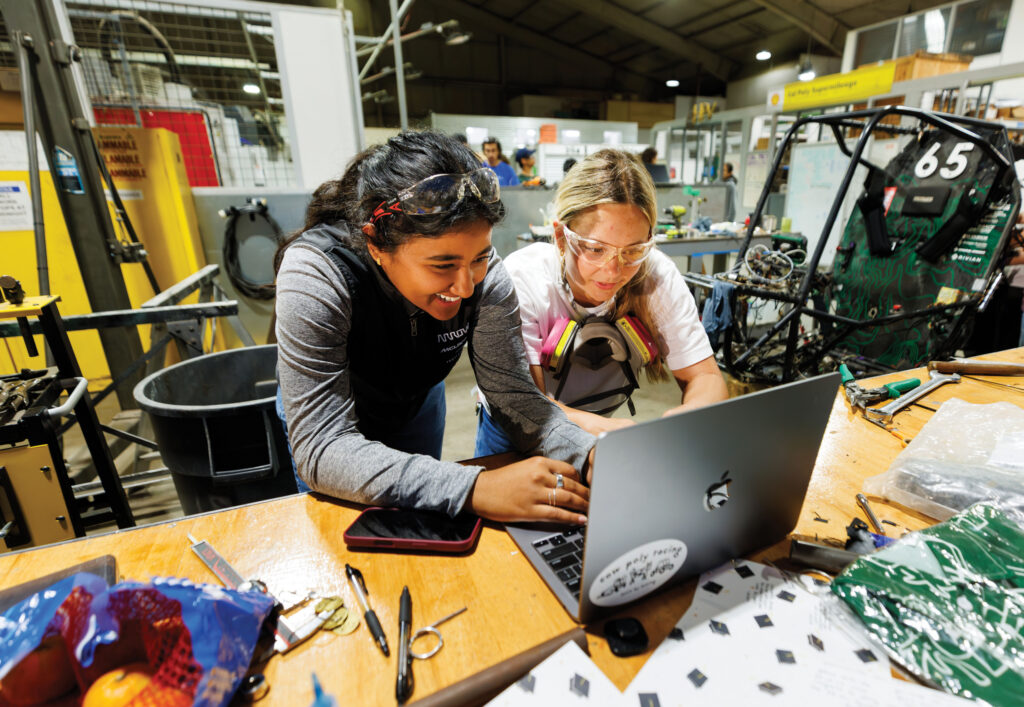
Ria Mehta, Cal Poly Racing’s president and Formula’s testing lead, focuses as much on culture as performance. She helps keep Baja, Formula and Business moving together, and pays closest attention to whether new members feel like they belong.
“If they feel seen, they stay and they learn,” Mehta said.
Materials engineering student Arisha Kabanova noticed another gap. Few materials students, especially women, made their way into Racing, even though Formula offered composite work many wouldn’t encounter until later in their coursework. This fall, she visited first-year MATE lectures, introduced herself and invited students to join.
“It worked,” she said. “First-years messaged me on Slack asking how to get involved, and now our materials group has far more women.”
The momentum shows in the subteams. Drivetrain has returning women for the first time in years. Electronics, once almost entirely male, now has its largest group of women to date. Electrical engineering students Malena Juergens and Serafina Alfonso stayed because Racing offered shared ownership and a supportive team.
“Four of us joined at the same time,” Alfonso said. “All four of us stayed.”
The shift is obvious to Boehle on a typical weeknight: women leading conversations about drivetrain, composites, aerodynamics and high-voltage systems.
Boehle blinked hard, eyes shining, as she talked about her teammates. “We’ve become a family,” she said. “Seeing people graduate is exciting, but a part of me doesn’t want to imagine Racing without them.”
The Through Line
The change inside Cal Poly Racing didn’t arrive at once. It grew through students who stayed long enough to leave the teams stronger than they found them. Webb insisted on teaching. Ghiglieri built on-ramps. Bernick made it normal to ask. Unti pushed to be heard.
The Hangar looks different because the people inside it do. You see it when newer members watch women teach machining on the CNC mills and during late work nights when women cluster around worktables where designs start to become real.
“Women before us had to fight to stay,” Giacalone said. “Now we get to build.”