
Among the bustle of students making their way to their first class of the school year, Brandon Mendoza walked through the crowd, taking in his new college campus.
In fall 2023, Mendoza began his first quarter at Cal Poly as a transfer student alongside 5,257 other first-time students. This was a fresh start for him after transferring from Santa Rosa Junior College.
“I was very excited to start and to finally take classes that had to do with my major,” the civil engineering student said.
In 2023, transfers like Mendoza made up fewer than 16% of the cohort, and while the new student was eager to begin his first year at Cal Poly, he soon realized that starting at a university during his junior year came with unexpected challenges.
“I think the onboarding was difficult since I wasn’t given a rundown on the classes that I’d need to take until a couple of hours before the sign-up time,” he said. “If I were given this information over the summer, it would have better prepared me to understand what classes I needed to take.”
Electrical engineering student Karina Escalera had a different onboarding experience.
“I received plenty of information during the transfer process regarding registering for classes,” she said. “The process was simple because of the guidance provided and the advisers available on registration day.”
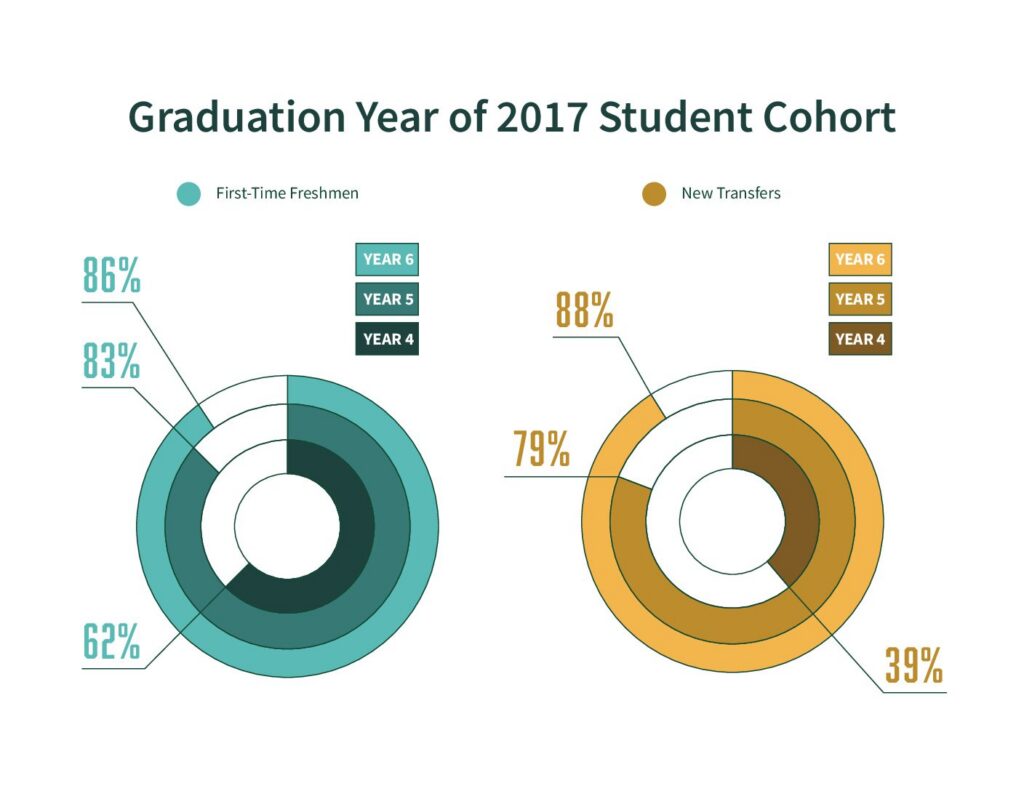
The time it takes to adapt can also impact how long it takes students to graduate. About 61% of first-year students from Cal Poly’s 2019 cohort graduated within four years, while only 38.9% of transfer students graduated within two years, meaning it takes the majority of Cal Poly transfers more than four years to earn an undergraduate degree. That’s if they spent only two years at their previous institution.
Some transfer students also commute to campus, cutting into study time and making it harder to meet new people through on-campus living or extracurriculars.
“I was nervous about transferring for many reasons, and I also had to commute four or five hours roundtrip during my first quarter,” Escalera said.
She reflected that the lack of sleep from commuting, along with her hectic class schedule made it hard for her to succeed, but she admits she could have reached out for help.
“There were many resources available to me, but I didn’t make use of them early on,” Escalera said. “When I finally met with an adviser, not one of them made me feel bad; in fact, they were supportive and understanding.”
Getting a Jump Start
While transferring can be a challenge, Cal Poly provides resources for students to help them acclimate to campus life.
One resource is the Transfer Student Jump Start Program — an initiative for mechanical engineering and computer science and software engineering transfer students to experience life at Cal Poly the summer before their junior year.
Mechanical engineering lecturer Sarah Harding and computer science and software engineering assistant professor Stephen Beard served as mentors and instructors for the 2024 Transfer Student Jump Start Program.
“The biggest benefit I see is helping students feel like they belong at Cal Poly by establishing a cohort, exposing them to campus resources and offering tours of our department spaces so they feel like they have been here a long time and that this is their school,” Harding said.
The program is a mix of coursework and campus experiences — giving students a crash course on Cal Poly and San Luis Obispo and showcasing what they may have missed out on learning organically during their freshman and sophomore years.
“As a transfer student alumnus of Cal Poly myself, trying to improve the experience of transfer students has been one of my primary objectives,” Beard said. “The Jump Start Program seemed like a great way to have a big impact not only on the experience of the students who participated, but to help me better understand how to help transfer students more generally.”
The program doesn’t just give students a briefing on Cal Poly — they also get an inside look at what San Luis Obispo has to offer. Harding and Beard take time out of their class sessions to share the best places in town for food, studying and outdoor activities, among other things.
“We are a true college town that depends on our students to keep it running,” Harding said. “I encourage students to attend community events, explore the hills and beaches, and try new things. College is a time for personal growth beyond the classroom.”
The Center of It All
While the Transfer Student Jump Start Program gives some engineering students an in, only a small fraction can take part in the program.
That’s where the Transfer Center comes in. The center is a hub for students, providing advocacy and information as they navigate university life.
“The Transfer Center’s main purpose is to empower and support transfer students to succeed and thrive at Cal Poly,” said the center’s assistant director, Amy Saldaña.
While it’s best for students to come to Cal Poly and hit the ground running, that can be a big ask for transfers, so the team at the Transfer Center designed and implemented the Cal Poly Transfer Student Hub Canvas course to give students the knowledge they need.
“The course serves as a sort of SLO Days part two to provide students with resources and opportunities early in their Cal Poly journey.”
Along with taking the Canvas course, students are encouraged to put in the work and get involved on campus.

Saldaña’s advice to transfer students is to take part in activities during their first or second quarter. Joining a club, attending Week of Welcome and participating in National Transfer Student Week events are all ways to meet new people and get involved.
“I think deciding to be part of a Week of Welcome group was very beneficial,” Mendoza said. “I made lifelong friends after hanging out with people for a week.”
For students seeking help with their classes, academic advising is one of the best resources. Students are encouraged to connect with an adviser to get on the right track when registering for classes. Engineering students in particular can reach out to Engineering Student Services.
“We work with transfers from admission to graduation to support them as they navigate their orientation experience to make sure they know what course credit they are bringing with them and what courses to take when they arrive,” said Katie Jennings, Engineering Student Services assistant director.
Transfer students can register for a one-unit course offered in the fall called Engineering Professional Success — a class to prepare students for what can be done with an engineering degree, as well as provide them with internship and job preparation.
The Mentor Collective is another resource. The program pairs transfer students with an upper-division mentor student to provide guidance and support while navigating Cal Poly.
At the end of the day, the goal is to give all students at Cal Poly the best hands-on, Learn by Doing education possible, and faculty and staff across campus are working to do just that.