

For years, hands-on learning has been a defining part of Cal Poly’s mechanical engineering program. While students are often at the center of that work, the resources that help move projects from idea to execution often happen behind the scenes.
That support comes in part from MEDAC, the Mechanical Engineering Discretionary-Fund Allocation Committee. Established in 2003 and supported today through donor-backed discretionary funds, MEDAC allows students to help direct resources toward tools, materials and equipment that strengthen learning across the department.
Each quarter, the committee reviews funding proposals from clubs, project teams and faculty-supported efforts. Members hear presentations, ask questions and vote on awards, ultimately allocating $50,000 to $70,000 each year. The focus is not just on what a project needs now, but on what investments can create shared, long-term value for students.
One of the most significant recent investments is a heat-treating furnace installed in the Mustang ’60 machine shop.
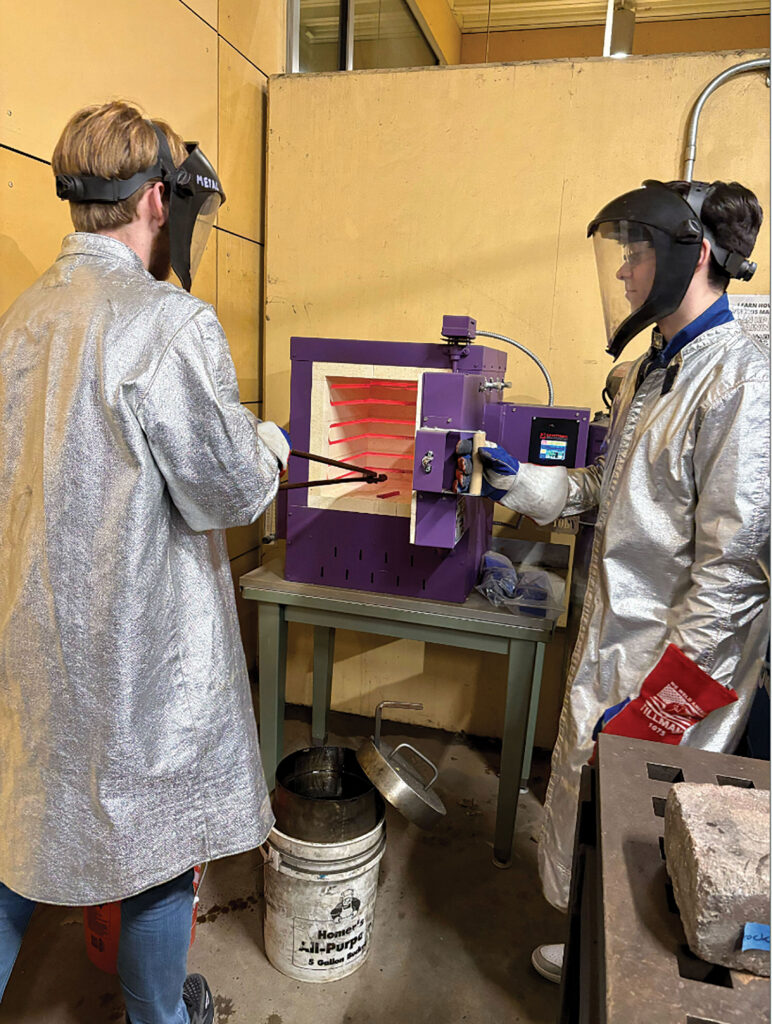
The furnace was funded through a MEDAC award submitted in fall 2023. Toby Sagi, a mechanical engineering student who proposed the purchase, said the goal was to expand what student teams could manufacture and test on campus by making heat treatment an accessible part of the process.
The equipment supports student teams working with steel components that require controlled heat treatment as part of manufacturing. “Every year, this furnace is one of the many critical tools used to build the Baja vehicle,” said Zachary Norris, a mechanical engineering student involved with the team. Baja designs and machines six powertrain shafts from 15-5 stainless steel and heat treats the stock before machining, he said, allowing the team to achieve high strength while avoiding warping or the need for post-machining heat treatment.
The furnace is also used by the Baja and Formula SAE teams to produce custom tooling, giving students more opportunities to design, fabricate and test components on campus rather than relying on outside processes.
One feature that has proven especially valuable is the furnace’s ability to purge the chamber with inert gas during heat treatment, which prevents oxidation and keeps parts clean.
“Without that feature, the part develops a scale from oxidization,” Sagi said. “Being able to control the environment makes a big difference in the quality of the final part.”
The equipment was selected with longevity in mind. Sagi said the furnace is expected to have a lifespan of at least five years, with the potential to remain in service for closer to a decade. That extended lifespan allows the investment to support multiple cohorts of students, reinforcing MEDAC’s emphasis on funding shared infrastructure rather than one-time purchases.
The heat-treating furnace is one example of how MEDAC funding translates into tangible learning opportunities. In recent quarters, the committee has supported a range of projects, from testing equipment and lab upgrades to specialized tools that allow teams to validate designs and iterate more effectively. These awards often address specific gaps — missing equipment, limited access or constrained budgets — that stand in the way of hands-on learning.
For student teams, MEDAC funding can be the difference between scaling back a project and fully exploring a design. For students serving on the committee, the process mirrors real-world decision-making. Members evaluate technical merit, feasibility and long-term impact while working within a finite budget.
That responsibility shapes how MEDAC operates. Meetings are open, deliberations are transparent and proposals are evaluated with an eye toward access and shared benefit. Through the process, students gain experience not only as engineers but as stewards of the resources that support their department.
As student projects continue to grow in scope and complexity, demand for flexible, student-directed funding continues to rise. Investments like the heat-treating furnace show how MEDAC funding can turn shared needs into lasting infrastructure — equipment that supports learning not just for one team or one quarter but for years to come.